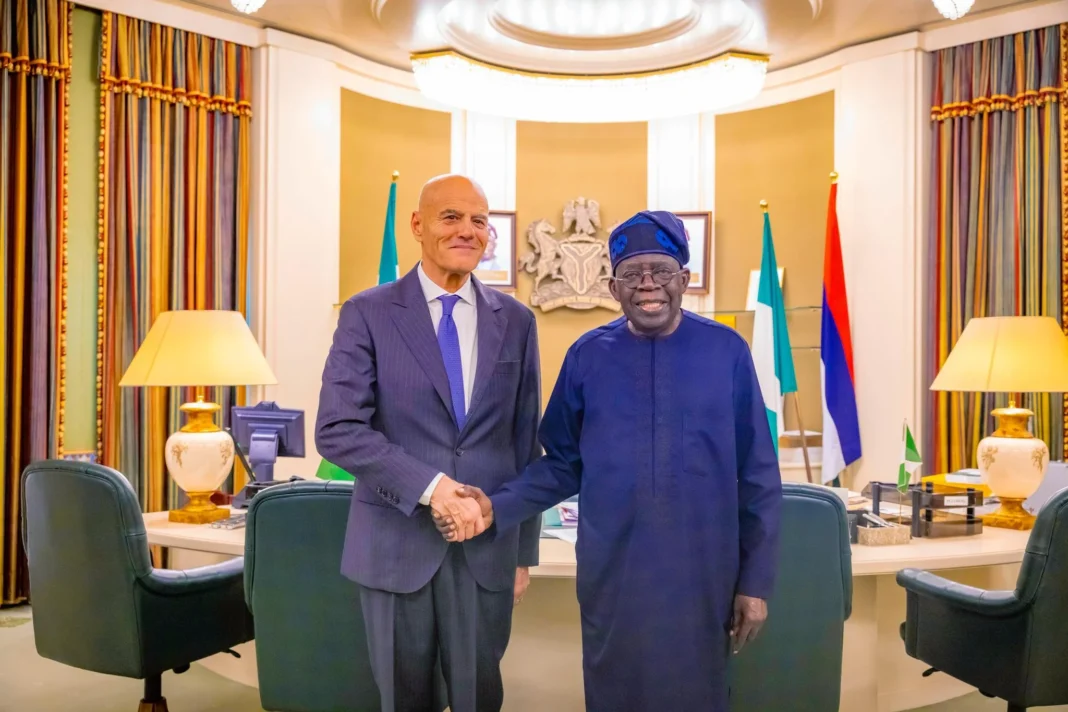
Eni Nigeria deepwater investment is gaining momentum after a high-level meeting between Nigeria’s President Bola Tinubu and Eni Chief Executive Officer Claudio Descalzi in Abuja. The discussions focused on expanding deepwater exploration in Nigeria’s offshore energy sector. Importantly, the meeting came after a major restructuring of Oil Prospecting Licence 245, which had remained undeveloped for decades.
Previously, legal disputes delayed the development of the OPL 245 oil block. However, the Nigerian government recently resolved these disputes through a negotiated settlement. As a result, authorities converted the block into four new licenses, creating a clearer path for investment.
Specifically, the government created two Petroleum Mining Leases, PML 102 and PML 103. In addition, two Petroleum Prospecting Leases, PPL 2011 and PPL 2012, were established. Consequently, the restructuring allows companies to proceed with exploration and production activities without ongoing legal uncertainty.
The settlement also led to the termination of arbitration proceedings at the International Centre for Settlement of Investment Disputes. Therefore, the Eni Nigeria deepwater investment strategy can now move forward without major legal barriers.
At the center of the project are two major offshore fields. These include the Zabazaba and Etan fields located under the newly created mining leases. Together, these fields represent one of Nigeria’s most significant deepwater opportunities.
Nigerian Agip Exploration Limited will operate the licenses. Meanwhile, the company will collaborate with partners Nigerian National Petroleum Company Limited and Shell Nigeria Exploration and Production Company Limited. As a result, the project combines international technical expertise with national energy interests.
Industry analysts estimate that the Etan-Zabazaba project holds about 500 million barrels of oil reserves. Consequently, the development could become one of the largest offshore oil projects in Nigeria.
Development plans include a floating production, storage, and offloading facility. The platform could produce around 150,000 barrels of oil per day at peak capacity. Furthermore, the project will also generate associated natural gas during production.
At peak output, associated gas volumes may reach 200 million standard cubic feet per day. Importantly, these gas volumes are expected to supply Nigeria LNG, which plays a key role in exporting natural gas to international markets.
The Eni Nigeria deepwater investment also builds on the company’s long history in Nigeria. Eni began operations in the country in 1962. Since then, the company has developed several offshore and onshore oil projects.
During discussions with Nigerian authorities, Eni also highlighted its broader offshore portfolio. For example, the company holds interests in producing assets such as the Abo and Bonga fields. In addition, it participates in Nigeria LNG, one of Africa’s largest gas export projects.
Recently, Eni strengthened its position in Nigeria’s offshore sector. Specifically, the company increased its stake in Oil Mining Lease 118 to 15 percent. As a result, it reinforced its presence in the country’s deepwater production industry.
Currently, Eni produces approximately 55,000 barrels of oil equivalent per day in Nigeria on an equity basis. However, the Eni Nigeria deepwater investment expansion could significantly increase this production in the coming years.
For many years, the OPL 245 oil block attracted global attention. In fact, it became the focus of one of the largest corruption trials in the oil industry. Consequently, overlapping lawsuits in multiple countries delayed development for nearly three decades.
Now, the restructuring of the block opens a new chapter. By dividing the asset into four licenses, Nigeria aims to accelerate exploration and production. Therefore, the government hopes to unlock the block’s enormous resource potential.
Energy experts estimate that the block may contain up to nine billion barrels of oil equivalent. If fully developed, these reserves could rival Nigeria’s existing proven oil reserves.
The Eni Nigeria deepwater investment could therefore reshape the country’s offshore oil sector. Deepwater projects often deliver stable production over long periods. Moreover, they typically support large-scale infrastructure and technology development.
Nigeria remains Africa’s largest oil producer. Consequently, oil revenues continue to play a critical role in the country’s economy. Offshore developments help maintain production levels as older onshore fields decline.
In addition, large energy projects generate significant economic benefits. Governments earn revenue through taxes, royalties, and production agreements. Meanwhile, local industries benefit from supply chain opportunities.
Engineering firms, logistics providers, and technical specialists often participate in offshore developments. As a result, such projects stimulate employment and industrial growth.
The Eni Nigeria deepwater investment also aligns with Nigeria’s broader strategy to attract international investors. The government aims to boost production while improving the investment climate in the energy sector.
At the same time, global energy companies continue seeking large offshore projects with strong reserves. Deepwater fields often offer long production lifespans and consistent output.
Nevertheless, several factors will influence the success of the project. These include regulatory stability, infrastructure capacity, and global energy demand.
If development progresses smoothly, the Zabazaba and Etan fields could become major offshore production hubs. Consequently, Nigeria could strengthen its role in global energy markets.
The recent meeting between President Tinubu and Eni’s leadership marks an important step toward that outcome. By resolving disputes and restructuring the license, Nigeria has created a pathway for major offshore investment.
Ultimately, the Eni Nigeria deepwater investment project represents both an economic opportunity and a strategic energy development for the country.