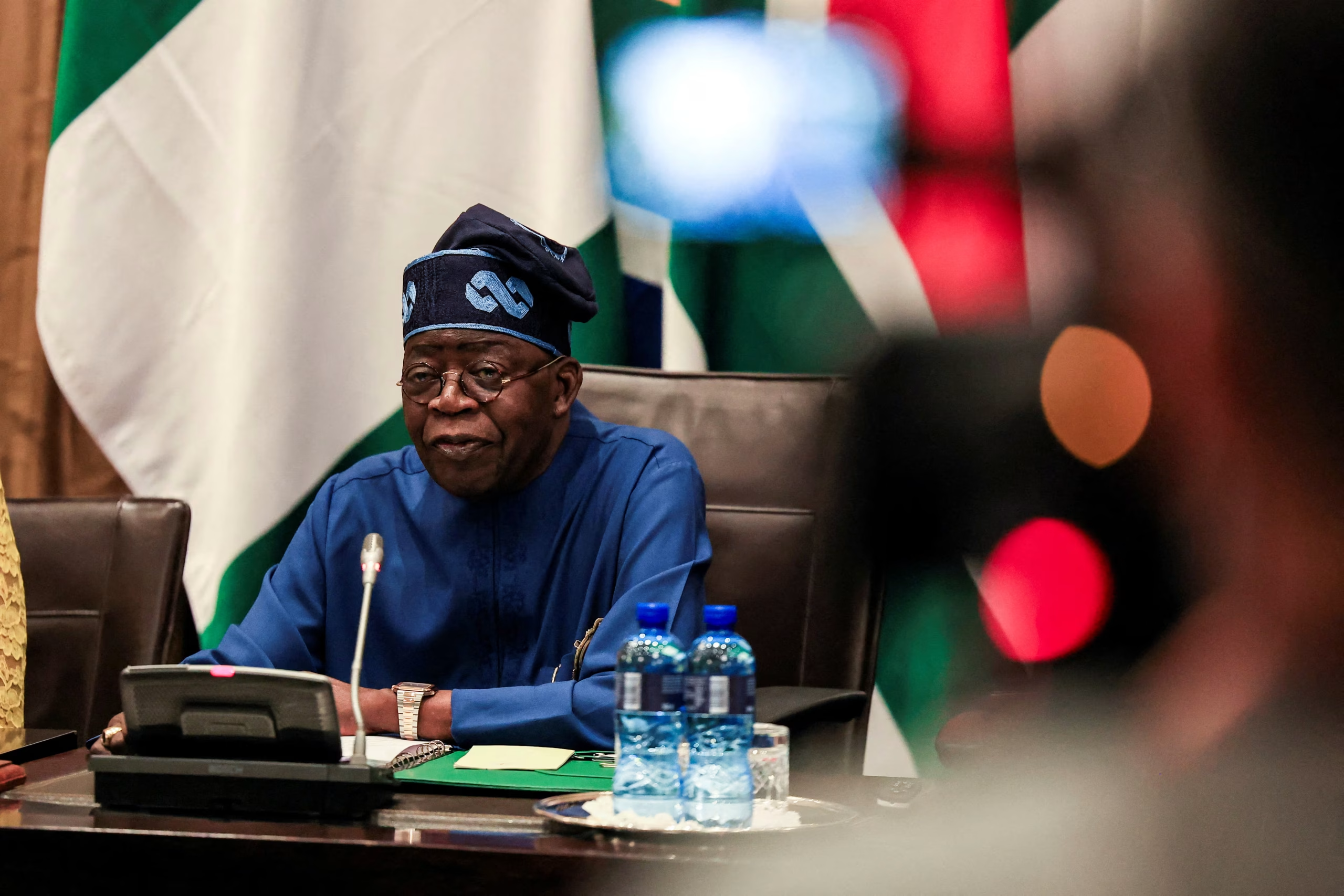
A storm is brewing in Nigeria’s political landscape. Over recent weeks, several governors and lawmakers have defected from opposition parties to the ruling All Progressives Congress (APC). These moves have triggered alarm from critics and opposition parties, who warn that President Bola Ahmed Tinubu may be laying the groundwork for a one-party state. Analysts are now closely watching whether democracy in Africa’s most populous nation can withstand this wave of political realignment.
The defections have occurred with increasing frequency as Nigeria edges toward the 2027 general elections. Among the most notable shifts: the governors of Enugu and Bayelsa states, long aligned with the Peoples Democratic Party (PDP) or other opposition blocs, have joined APC. The ADC (African Democratic Congress) has decried these moves as proof that “President Tinubu is bent on turning Nigeria into a one-party state.”
Supporters of Tinubu argue the defections validate his leadership and the appeal of his governance agenda. For example, FCT Minister Nyesom Wike recently claimed that these shifts vindicate his support for Tinubu and signal a larger political realignment across states. Nonetheless, opposition figures and civil society see a more dangerous trend: shrinking political space, consolidation of power, and erosion of checks and balances.
Why the Defections Matter
1. Weakening the Opposition
Each defection chips away at the strength of opposition parties. When governors cross over, they bring resources, patronage networks, and influence. The governing APC thereby accrues dominance not only in federal structures, but also at state and local levels.
Critics argue that instead of winning on policy or public trust, APC is “capturing” opposition through incentives, coercion, or political promises. The ADC contends that these defections are not acts of conviction but moves driven by personal ambition or fear of being marginalized.
2. Centralization of Power
In a healthy democracy, the balance between national power and state-level autonomy is key. But when states shift allegiance en masse, the central government gains a uniform base of support across the federation. This reduces institutional barriers that might otherwise restrain overreach or abuse of authority.
Moreover, if state governors fear political isolation, they may conform more to federal directives, stifling dissent and decentralization. The result: a more uniform political order that favors central consolidation.
3. Institutional Capture & Co-optation
Observers also worry that state institutions—judiciary, police, regulatory agencies—may be co-opted to reinforce APC dominance. With fewer opposition governors and state-level resistances, federal influence over appointments, funding, and oversight strengthens.
Already, moves like declaring states of emergency (e.g. in Rivers State earlier this year) have spotlighted the federal government’s capacity to intervene in state affairs. Critics fear such tools, in conjunction with party dominance, tilt the playing field heavily in favor of the ruling party.
4. Symbolism & Momentum
Symbolically, these defections send a message: “Join or be marginalized.” That perception alone can dissuade would-be critics, suppress dissent, or induce further defection. In politics, momentum matters. The idea that “everyone is moving to APC” can become a self-fulfilling prophecy.
Reactions, Denials & Political Posturing
Tinubu’s Denial
President Tinubu and his aides have publicly denied any designs to turn Nigeria into a one-party state. In a Democracy Day speech earlier in 2025, Tinubu asserted:
“At no time in the past … nor any instance in the present, and at no future juncture shall I view the notion of a one-party state as good for Nigeria.”
He insists that the defections reflect genuine alignment with his policies and governance direction, not coercion or subversion of democracy.
However, the denial has done little to quiet opponents. Some within the APC have also voiced caution. Senator Ali Ndume, for instance, warned that one-party dominance is a threat to democracy itself.
Opposition Outcry
Opposition parties have strongly reacted. The ADC lambasted the defections as a “betrayal of trust” and a “gang-up” against democracy. The party insists that the 2027 general election will be a struggle between the people of Nigeria and what it terms “Tinubu’s gang of governors.”
Other opposition leaders are forming new alliances to counterbalance APC’s dominance. The Africa Democratic Congress (ADC) and allied figures like Abubakar Atiku and Peter Obi have launched coalitions aimed at preventing the consolidation of a one-party regime.
Civil Society, Media & Public Alarm
Civil society groups, media commentators, and democracy advocates express deep concern. Many warn that mass defections weaken institutional checks, weaken democratic competition, and embolden authoritarian drift. The possibility of shrinking space for dissent, journalism, and opposition campaigning now occupies front pages.
Some youth-led protests have already emerged, especially in urban hubs like Lagos, voicing frustration with governance and perceived political capture.
Historical & Comparative Context
Nigeria’s democracy has always grappled with party defections. From its First Republic period to the Fourth Republic, party-switching has been part of political life. But the scale and timing of recent defections raise new alarms.
In comparative terms, many democracies have experienced similar centralizing pressures when ruling parties monopolize power. The distinction between multiparty competition and dominant-party systems can blur, especially when state machinery aligns with a single party.
For instance, in some African nations, ruling parties have absorbed opposition through incentives, persecution, or legal restriction—evolving into one-party dominance even without formally abolishing pluralism.
Risks, Challenges & Fragilities
Legitimacy Crisis
If opposition is hollowed out, public trust in elections, institutions, and governance may erode. Citizens might see elections as predetermined, civic participation declining, and political apathy growing.
Internal APC Tensions
Even within APC, some voices warn against unchecked dominance. A party that lacks credible internal critique or dissent risks groupthink, corruption, and policy failure.
Electoral Backlash & External Pressures
In 2027, if the electorate sees APC dominance as undemocratic overreach, there is potential for backlash—through protest, voter mobilization, or judicial challenges. International observers, foreign governments, and multilateral institutions may also pressure Nigeria on electoral integrity.
Sustainability of Defections
Defectors often face backlash from local constituencies. Governors who leave expected party mandates risk losing their base support if voters perceive opportunism. If defectors fail to deliver locally, they may become liabilities rather than assets.
Structural Weaknesses
Underlying economic hardship, insecurity, inflation, and public discontent may still overwhelm political dominance. Popular discontent can erupt no matter which party holds majority.
Looking Ahead: Key Indicators to Watch
- Further Defections — Will more governors, legislators, or regional leaders cross over to APC? If so, how many, and how quickly?
- Electoral Laws & Reforms — Will the government alter laws (e.g. on party funding, electoral commission independence, or candidate qualification) to cement advantage?
- Federal Interventions in States — Watch for more declarations of states of emergency, suspension of governors, or federal interference in state structures (as seen in Rivers).
- Opposition Coalitions & Revival — The strength, unity, and organizational capacity of opposition blocs will test whether they can resist dominance. The ADC-led coalition is a key barometer.
- Civil Society & Media Freedom — Will space shrink for critical journalism, dissent, or accountability institutions?
- Public Sentiment & Protests — If citizens perceive governance as a takeover, social unrest or protest movements could grow.
Conclusion
“Hurricane Tinubu” may be the apt metaphor — a political storm of defections that reshapes Nigeria’s governing landscape. The consolidation of governors and officials into the ruling party raises serious concerns over democratic erosion, institutional capture, and the potential slide toward a one-party dominant system.
While Tinubu denies any intent to subvert multiparty democracy, actions speak loudly. The magnitude and timing of defectors, coupled with structural interventions, suggest more than coincidence. The next two years will test Nigeria’s democratic resilience. Will opposition forces regroup and resist, or will this realignment mark a decisive shift in the country’s political architecture?