The Nigerian government has firmly denied claims of a “Christian genocide” and rejected former U.S. President Donald Trump’s warning of potential U.S. military intervention.
Officials said the accusations were misleading and risked misrepresenting Nigeria’s ongoing struggle against terrorism and communal violence.
At stake are key issues — national sovereignty, security cooperation, and Nigeria’s global image.
The U.S. Accusations and Threat
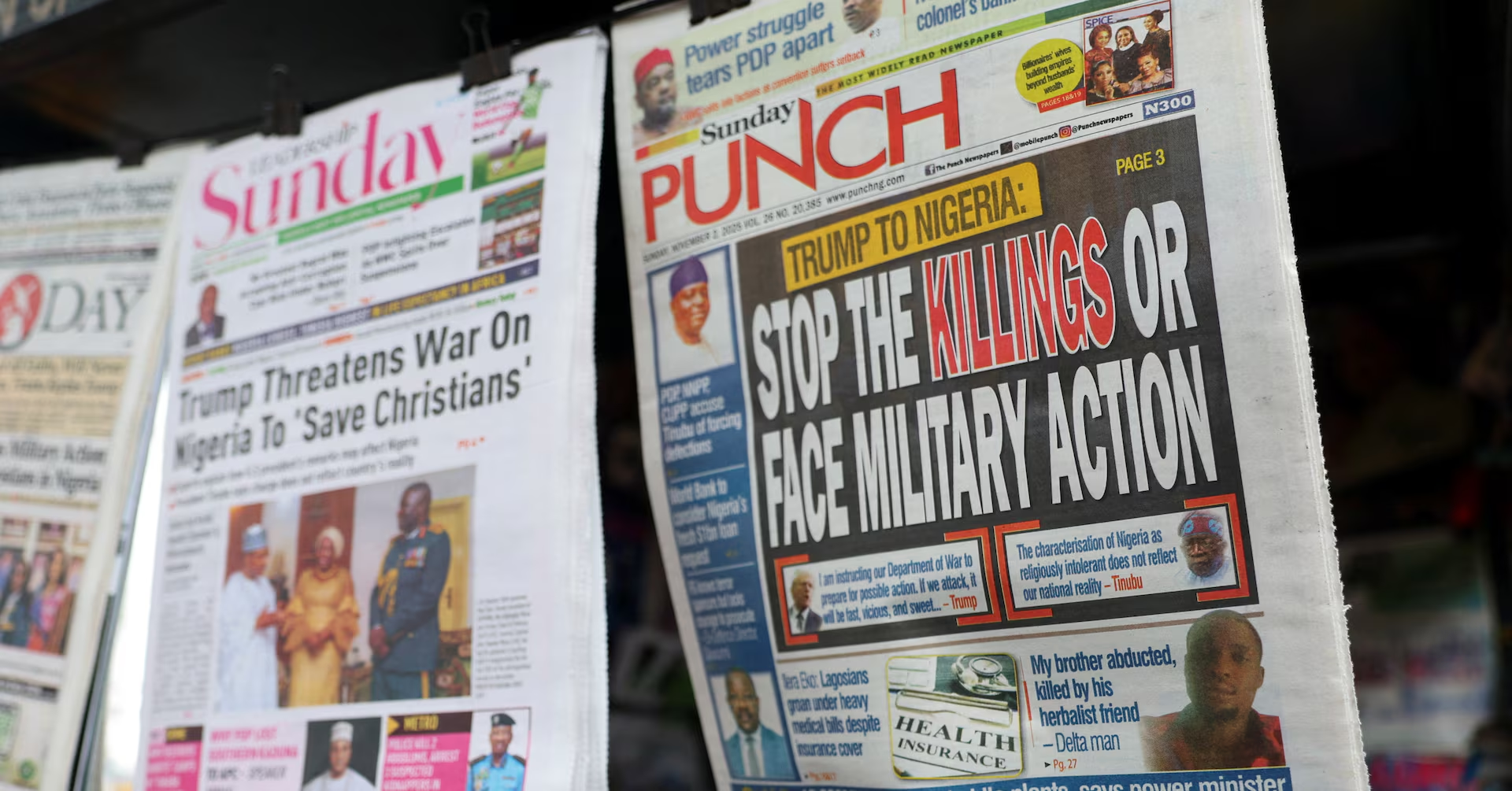
On 1 November 2025, Donald Trump announced that he had directed the U.S. Department of War (formerly the Pentagon) to prepare for possible military action in Nigeria.
He accused the Nigerian government of failing to stop “Islamic terrorists” from killing Christians.
In a post on his social media platform, Trump warned that if Nigeria “did not act,” the U.S. would “immediately stop all aid and may very well go into that now disgraced country, guns blazing.”
He also said Nigeria had been redesignated a Country of Particular Concern under U.S. law for religious freedom violations.
The U.S. message was clear: act against Christian persecution or face aid cuts and possible military involvement.
Nigeria’s Response
The Nigerian presidency, through spokesman Daniel Bwala, dismissed the accusations and described Trump’s approach as “forceful diplomacy.”
Bwala said the claims were based on “misleading reports” and do not reflect Nigeria’s security realities.
He stressed that Nigeria would not accept unilateral U.S. military action and that any cooperation must respect its sovereignty.
President Bola Ahmed Tinubu echoed this view, calling the “religiously intolerant” label inaccurate.
“Our government protects freedom of religion and belief for all Nigerians,” Tinubu said.
Nigeria, he added, welcomes assistance — but only when offered in mutual partnership, not under threats.
Are Christians Being Systematically Targeted?
Violence in Nigeria is complex, involving Islamist insurgents, armed herders, communal conflicts, and criminal gangs.
These crises affect both Christians and Muslims.
Analysts note that most attacks are not driven purely by religion but by ethnic, geographic, and resource-based disputes.
A Reuters review of data from ACLED showed that out of 1,923 civilian attacks in 2025, only 50 were clearly targeted at Christians.
Some advocacy groups have claimed that 50,000 Christians have been killed and 18,000 churches destroyed since 2009.
However, these figures are disputed and lack verifiable evidence.
The Nigerian government called them “false and misleading,” arguing that such narratives oversimplify a deeply rooted security crisis.
Why the U.S. is Linking Aid to Religion
This is not the first time Nigeria has faced U.S. scrutiny over religious freedom.
Washington first added Nigeria to its Countries of Particular Concern list in 2020 but removed it in 2023.
Trump’s renewed designation reflects growing pressure from U.S. evangelical and conservative groups.
From his perspective, defending persecuted Christians is both a moral and political stance.
However, experts warn that focusing solely on religion ignores the broader drivers of violence and risks damaging counter-terrorism cooperation.
Mischaracterising Nigeria’s conflict as “religious” could strain relations and complicate future partnerships.
Implications for Nigeria
Sovereignty and diplomacy: Nigeria insists that any foreign operation on its soil must be approved jointly by both governments.
“Matters of military operation are not unilateral decisions,” Bwala said. “Nigeria remains a sovereign state.”
Security cooperation: The U.S. has supported Nigeria in intelligence sharing and counter-terrorism training.
If ties weaken, those collaborations could suffer, undermining the fight against Boko Haram and IS-West Africa.
Religious harmony: Nigerian leaders fear Trump’s remarks could inflame interfaith divisions.
Oba Rilwan Akiolu I, the traditional ruler of Lagos, criticised Trump’s statements and warned they could “deepen mistrust where unity is most needed.”
Public perception: Many Nigerians believe the “Christian genocide” label misrepresents the crisis.
Local communities report that both Muslim and Christian villages are targeted by armed groups for ransom or resources, not religion.
Implications for the U.S. and Global Policy
Aid leverage: The Trump camp’s threat to cut U.S. aid suggests Washington may increasingly link funding to religious-freedom scores.
Military role: Talk of air strikes or troop deployment raises questions of legality and U.S. interventionism.
Can the U.S. act without Nigerian approval? Analysts say doing so would breach international law.
Diplomacy vs. narrative: Responding strongly to persecution claims may please U.S. voters but risks undermining long-term security cooperation.
Global precedent: Using religious freedom as a basis for intervention could set a new global precedent — one that might expand U.S. influence but also its foreign entanglements.
What to Watch Next
- Independent investigations: Verification of alleged religious attacks will be vital for credibility.
- Nigerian policy moves: The government may step up protection for vulnerable communities to ease pressure.
- U.S. decisions: Washington could impose sanctions, delay aid, or escalate military readiness.
- Regional response: ECOWAS nations may object to any unilateral U.S. military involvement in West Africa.
- Public discourse: The framing of Nigeria’s crisis — religious or political — will shape both diplomacy and domestic harmony.
- Aid flows: Reduced U.S. support could affect Nigeria’s counter-terrorism capabilities and humanitarian programs.
Summary
In essence, Trump’s accusations have reignited a sensitive debate.
Nigeria rejects the idea that it is a nation waging war on Christians, arguing the violence stems from terrorism, poverty, and weak governance — not state policy.
For Washington, the issue intersects religion, human rights, and strategic influence.
For Nigeria, it’s about sovereignty and global reputation.
While both sides have reasons for their stance, experts caution that religious rhetoric could overshadow shared interests in stability and counter-terrorism.
Whether the U.S. turns words into action — and how Nigeria reacts — will define the next phase of U.S.–Nigeria relations.