Uganda Private Capital has crossed a symbolic threshold. In an economy valued at roughly 65 billion dollars, the combined estimated wealth of the country’s 15 largest private fortunes now stands at about 10.3 billion dollars. That figure represents nearly one sixth of national output.
This concentration has emerged in a context where public capital markets remain limited in depth and liquidity. The Uganda Securities Exchange plays a role, but it does not define the commanding heights of wealth. Instead, commercial real estate, petroleum distribution, hospitality, manufacturing and selective telecom equity stakes have formed the backbone of Uganda Private Capital.
The following ranking presents asset-based estimates grounded in publicly verifiable holdings and sector valuation benchmarks. The figures are indicative rather than audited disclosures, yet they reveal clear structural patterns.
1. Hamis Kiggundu
Estimated Net Worth: 1.35 Billion Dollars
Kiggundu’s capital base is rooted in high-density commercial real estate across Kampala. Through successive development cycles, he has reinvested rental income into mixed-use towers, retail complexes and infrastructure-linked redevelopment zones.
Strategic land banking strengthens long-term optionality. Beverage manufacturing operations add industrial depth, while fintech participation introduces digital transaction exposure. International property holdings reportedly spanning Europe, North America and the Gulf provide currency diversification. His structure reflects reinvestment-led asset expansion rather than equity market dependence.
2. Sudhir Ruparelia
Estimated Net Worth: 1.2 Billion Dollars
Ruparelia’s wealth sits within one of Uganda’s most diversified conglomerates. Commercial real estate anchors the balance sheet. Hospitality estates such as Speke Resort Munyonyo generate operational revenue linked to tourism and conference demand.
Insurance, education and floriculture exports introduce institutional and foreign exchange-linked income streams. His structure spreads risk across property appreciation and enterprise turnover, reinforcing his standing within Uganda Private Capital.
3. John Bosco Muwonge
Estimated Net Worth: 850 Million Dollars
Muwonge represents the archetype of the central business district landlord. His arcades and multi-storey commercial buildings across Kampala’s busiest corridors generate rent-intensive income driven by retail density.
Scarcity of prime inner-city land remains the primary multiplier of his valuation.
4. Drake Lubega
Estimated Net Worth: 800 Million Dollars
Through Jesco Industries Limited, Lubega has accumulated extensive commercial property in high-footfall trading zones. His model emphasizes acquisition, vertical expansion and tenant densification.
Industrial facilities and education investments provide modest diversification, but real estate remains the dominant engine of capital growth.
5. Mansour Matovu
Estimated Net Worth: 785 Million Dollars
Matovu’s wealth evolved from logistics and trading into structured commercial property ownership. Arcades such as MM Plaza and Jumbo Plaza generate recurring income from dense tenant ecosystems.
His valuation depends heavily on land positioning and steady rental turnover in Kampala’s retail corridors.
6. Karim Hirji
Estimated Net Worth: 785 Million Dollars
Hirji blends hospitality, automotive distribution and commercial property under the Dembe Group. Imperial Hotels anchor tourism-linked revenue streams, while Cham Towers stabilizes long-term capital through prime real estate ownership.
The hybrid model balances asset-backed security with operational cash flow sensitivity.
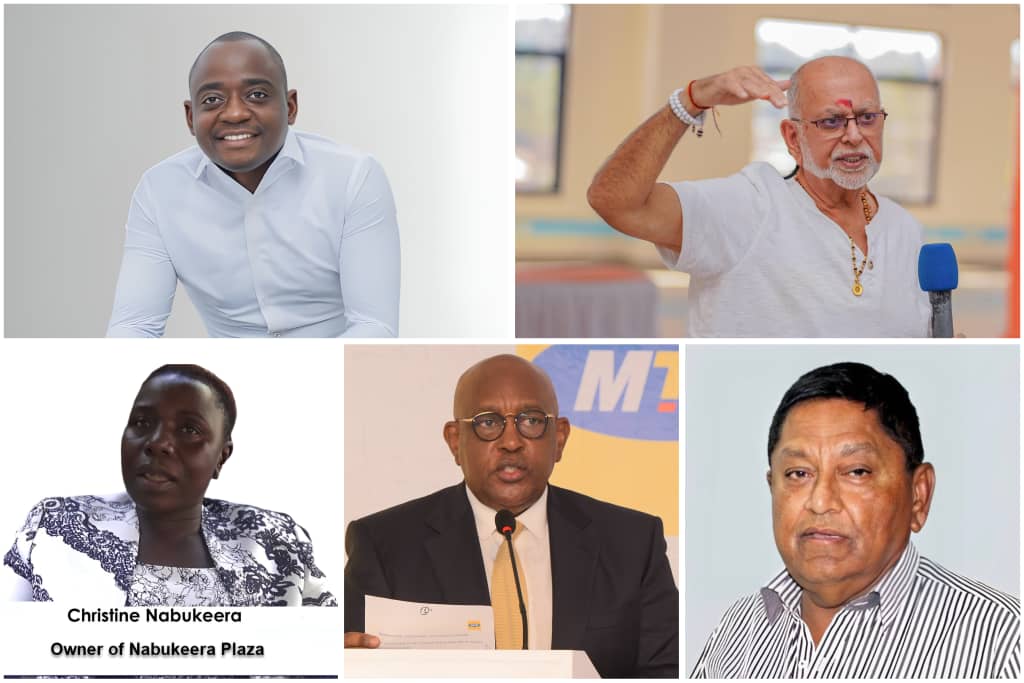
7. Christine Nabukeera
Estimated Net Worth: 710 Million Dollars
Nabukeera’s wealth is concentrated in premium commercial and residential property. Landmark assets such as New Pioneer Mall exemplify disciplined land acquisition and long-horizon development strategy.
Her valuation is tied closely to rental yield performance and infrastructure-driven appreciation.
8. Tom Kitandwe
Estimated Net Worth: 700 Million Dollars
Kitandwe transitioned from commodity trading into large-scale urban development. Commercial holdings across major intersections generate stable rental income.
Land and agribusiness investments introduce production exposure and long-term capital preservation. Telecommunications-linked participation adds a growth dimension within Uganda Private Capital.
9. Guster Lule Ntake
Estimated Net Worth: 670 Million Dollars
Ntake’s structure reflects industrial diversification. Hospitality assets generate service-sector income. Agricultural operations and food processing facilities extend value into production and manufacturing.
Property holdings offer stability, while enterprise turnover adds scalable revenue potential.
10. Godfrey Kirumira
Estimated Net Worth: 615 Million Dollars
Kirumira built his base through petroleum distribution. Fuel retail provides recurring liquidity tied to transport demand and commercial activity.
Commercial towers, hospitality properties and telecom infrastructure diversify income streams and anchor asset-backed value. His model combines operational turnover with tangible preservation.
11. Charles Mbire
Estimated Net Worth: 600 Million Dollars
Mbire represents the equity-driven segment of Uganda Private Capital. His stake in MTN Uganda positions him among the most prominent individual shareholders on the local exchange.
Telecommunications exposure links his wealth to subscriber growth, digital finance adoption and dividend performance. Investments in energy and infrastructure expand sector diversification.
12. Amos Nzeyi
Estimated Net Worth: 550 Million Dollars
Nzeyi’s capital is fundamentally industrial. Beverage manufacturing through Crown Beverages anchors valuation through production scale and consumer demand.
Hospitality and food production provide additional recurring revenue. His structure reflects enterprise building over property accumulation alone.
13. Ahmed Omar Mandela
Estimated Net Worth: 535 Million Dollars
Mandela’s vertically integrated portfolio spans petroleum retail, food service and agro-processing. City Oil delivers high-volume distribution cash flow. Café Javas reinforces consumer brand positioning.
Mandela Millers links agricultural supply chains to urban demand, introducing industrial depth.
14. Haruna Sentongo
Estimated Net Worth: 490 Million Dollars
Sentongo focuses on redevelopment-driven commercial property in dense urban zones. Markets and arcades across key trading hubs generate rent-intensive income.
Tenant density and strategic positioning near transport corridors support valuation stability.
15. Patrick Bitature
Estimated Net Worth: 220 Million Dollars
Bitature’s wealth emerged from telecommunications distribution before expanding into energy infrastructure and hospitality. Electro-Maxx positions him within Uganda’s power generation ecosystem.
His portfolio blends infrastructure-backed exposure with operational enterprise income.
The Pattern Beneath the Ranking
The defining feature of Uganda Private Capital is its tangible orientation. Commercial real estate dominates. Petroleum distribution follows. Manufacturing and selective equity stakes complete the hierarchy.
In a lower-middle-income country where a large portion of economic participation remains informal, ownership of land and large-scale distribution networks creates high barriers to entry. Access to development finance and prime locations compounds wealth faster than wage growth or small enterprise expansion.
As oil production scales and financial markets deepen, the architecture may shift gradually toward broader participation. For now, Uganda Private Capital remains shaped by those who control the physical infrastructure of commerce, from shopping arcades and fuel stations to factories and telecom equity stakes.